The Most Important Network in America Still Runs on Floppy Disks
Washington is finally rewiring US airspace: $12.5 billion down, $30 billion to go, on a 2028 deadline. Here's where the money is flowing, why the headline names are the wrong play, and the one listed pure play most investors have never heard of.

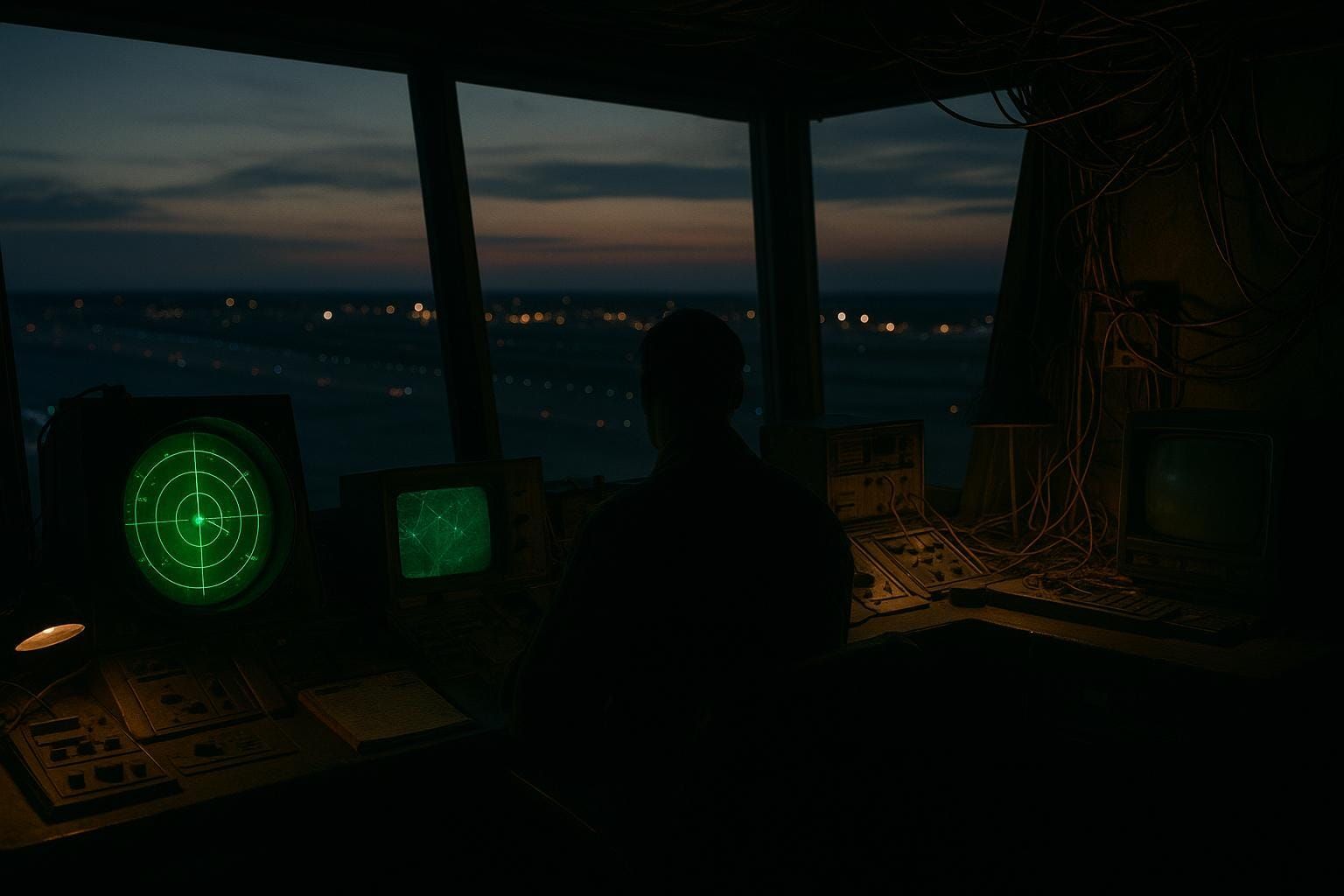
There is a room in Warrenton, Virginia, where flight data still moves on floppy disks. Across the country, air traffic controllers hand each other strips of paper to track aircraft, talk to pilots over radios older than the controllers themselves, and depend on copper telephone wires that fail so often the FAA classifies the outages by the hour. This is the network that manages more than 18 million flights and over a billion passenger movements a year — the largest, most complex airspace system in the world, running on infrastructure that predates the internet.
For decades, everyone agreed it needed replacing and nobody paid for it. Then, on January 29, 2025, an Army Black Hawk collided with a regional jet on approach to Washington National, killing 67 people. Within eighteen months, Congress had done something it had failed to do for a generation: write a very large check.
The $12.5 billion down payment
The One Big Beautiful Bill Act, signed July 4, 2025, appropriated $12.5 billion for air traffic control modernization — described by Transportation Secretary Sean Duffy, notably, not as the fix but as a "down payment." The full rebuild is widely estimated to exceed $30 billion.
The initial allocation breaks down like this:
- $4.75 billion to replace telecommunications infrastructure — the copper-to-fiber-and-wireless conversion that underpins everything else
- $3 billion to replace radar systems, most of which date to the 1970s and 80s
- $1.9 billion to build one brand-new en route control center — the first in decades — consolidating three existing centers
- $1 billion to consolidate terminal approach control facilities
- $500 million for runway safety technology, plus smaller tranches for digital information displays, controller training systems, weather stations, and remote towers
The hardware targets are concrete: 27,000 new radios, 450 digital voice switches, 612 new radar systems, and surface surveillance systems to track aircraft on the ground at more than 200 airports — the technology that could have flagged several near-collisions that made headlines in 2023 and 2024.
Briefings like this are free to read with a free AlphaBriefing membership. Join free →
This time is measurably different
Skepticism is warranted. The FAA's last grand modernization effort, NextGen, launched in 2007, consumed well over a decade and tens of billions of dollars, and still left the system running on paper strips and copper. What distinguishes the current effort is speed and transparency: Duffy has publicly committed to completing the core upgrades by 2028 — a two-and-a-half-year window — and the DOT launched a public tracker (Modern Skies) that updates progress monthly, project by project, down to the ZIP code.
The early numbers are real. As of late May 2026, the copper wire replacement was 51% complete and radio conversions stood at 18%, with more than 10,000 individual projects underway nationwide. FAA Administrator Bryan Bedford, meanwhile, is already back before the Senate asking for the next tranche — including billions for an AI-based traffic management software layer designed to predict and resolve congestion 45 days in advance.
Washington has committed the money. The engineering is underway. Which leaves the question that matters for investors: $12.5 billion is being wired out of the Treasury on a compressed timeline — and it is landing on a surprisingly short list of companies.
The rest of this briefing is for paid members: the contractor-by-contractor map of where the $12.5 billion is actually flowing, the materiality math showing why the biggest name involved is the wrong play and the foreign mid-cap is the right one, the second-order beneficiaries in fiber and construction, the funding-gap risk nobody is modeling, and the catalyst calendar through 2027.
AlphaBriefing Paid gets you every investment thesis, scenario framework, and catalyst brief we publish — the analysis private intel clients pay four figures for, at a fraction of that.