Air Traffic Control Just Got an AI Brain. The Wires Are Still From the 1960s.
The FAA switched on its AI airspace planner the same day one cut cable grounded five airports. Inside the $12.5 billion modernization with no master schedule — and the $30 billion ask behind it.

Last Monday morning, September 21, Transportation Secretary Sean Duffy stood in Washington and unveiled what he called a fundamental reshaping of how America manages its skies: an AI-supported platform named SMART that would predict congestion before it happens and slash the delays that have made U.S. air travel a national grievance.
Within hours, a construction crew working along an Amtrak rail line in New Jersey had severed a fiber-optic cable — and with it, the connection between air traffic controllers and the airplanes over one of the busiest corridors on Earth. Ground stops hit Newark, JFK, LaGuardia, Philadelphia, and Teterboro. Thousands of flights were delayed or canceled across the Northeast before crews repaired the line that evening.
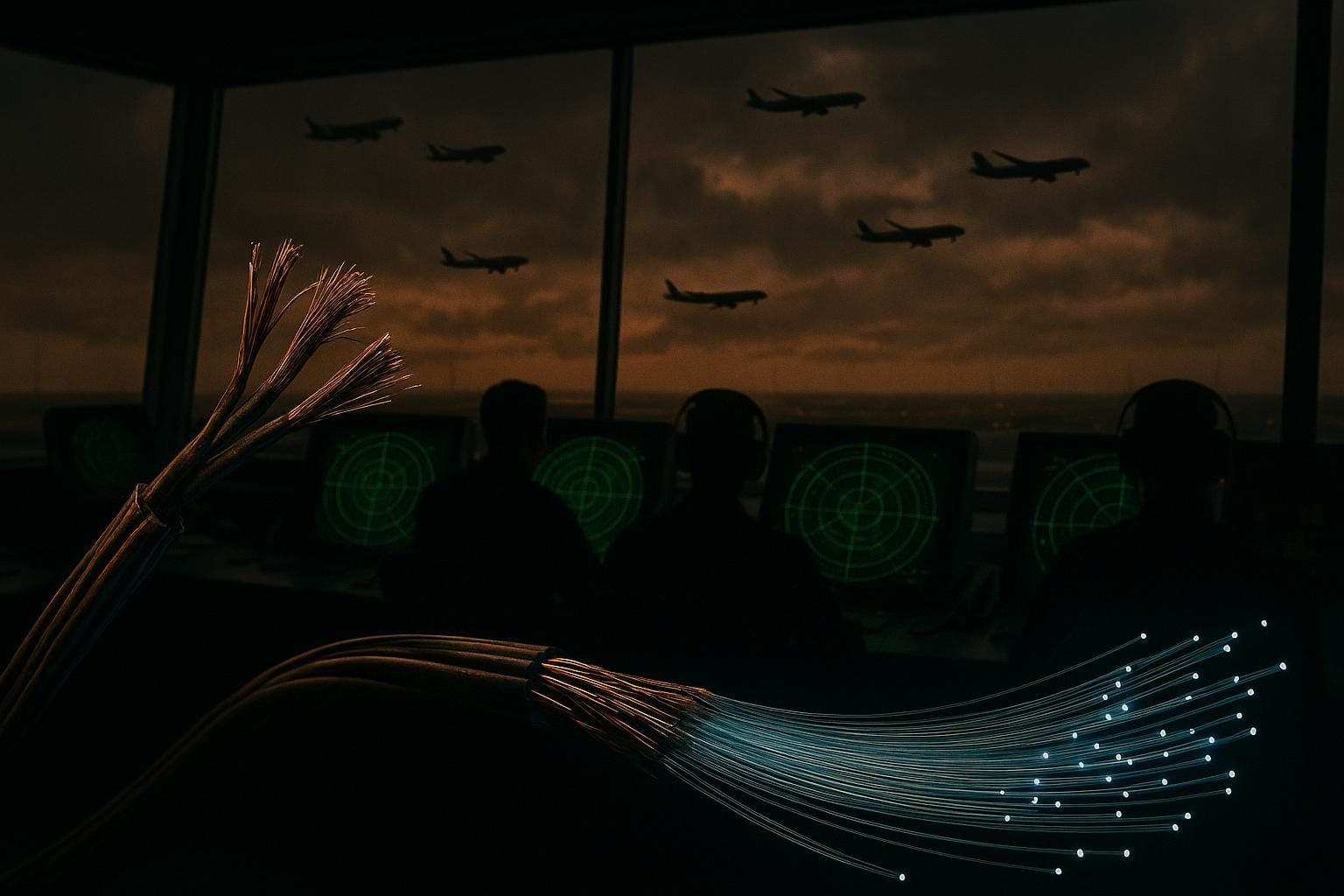
One day. Both stories. That split screen is the most honest picture of American air traffic control you will find: a 21st-century brain being bolted onto a nervous system that still runs, in thousands of places, on copper wire installed when Lyndon Johnson was president.
What Actually Broke
The failure chain was almost absurdly analog. According to FAA Administrator Bryan Bedford, the primary telecommunications circuit serving the Philadelphia Terminal Radar Approach Control facility — PHL TRACON, which handles approach and departure traffic for Newark, Philadelphia, and Teterboro — failed that morning. The system did what it was designed to do and switched to its backup line.
The backup had already been cut. Duffy said an Amtrak construction crew accidentally severed the fiber-optic cable, which runs alongside the railroad's right-of-way. Verizon, which operates the affected lines, said its facilities had been functioning up to that point and denied responsibility, according to press accounts. Because the New York and Philadelphia airspaces are scheduled as one tightly coupled system, the outage cascaded: departure delays stretched to 150 minutes, and flight-tracking data cited in press reports showed hundreds of cancellations at Newark alone by evening.
If PHL TRACON sounds familiar, it should. The facility took over Newark's airspace from the New York TRACON in July 2024 — a transfer meant to fix staffing shortages — and has since produced a string of high-profile failures, including radar and radio blackouts in the spring of 2025 that briefly left controllers unable to see or talk to aircraft. After one incident that April, five controllers took trauma leave and more than 1,000 flights were canceled. The National Air Traffic Controllers Association has warned repeatedly that the facility operates below target staffing.
So when a single cut cable can ground five airports, the question isn't whether the system needs modernizing. It's whether the modernization now underway is being run well enough to work.
Briefings like this land in members' inboxes before the market prices them in. Join free →
The AI Layer: What SMART Is and Isn't
SMART — Strategic Management of Airspace, Routes and Trajectories — is not an AI controller talking to pilots. It is a planning tool. According to the Department of Transportation, it pulls roughly 200 data streams — weather, flight paths, traffic flow, controller staffing — into one platform, and its AI-supported engine forecasts where congestion will build hours, days, or weeks ahead so the FAA can adjust schedules before problems compound. Every recommendation is reviewed by FAA staff, and local facility managers can accept or ignore its suggestions.
The FAA switched it on in limited mode around Washington, D.C. on September 21, with a staged national expansion planned over the coming months. The Wall Street Journal reported the contract at $875 million, held by aviation software firm Air Space Intelligence (ASI) — a detail that briefly confused markets, since traders bid up Palantir on the news even though ASI, not Palantir, won the work.
The airline C-suite showed up for the launch anyway. United's Scott Kirby said SMART could "do more to reduce delays and cancellations than anything that's happened in decades." Delta's Ed Bastian, American's Robert Isom, and Southwest's Bob Jordan all offered support. When every major carrier CEO blesses a government IT project on day one, they are telling you where their operating costs live: in the daily tax that a congested, reactive airspace system levies on fuel, crews, and schedules.
Not everyone applauded. Rep. Don Beyer, whose Northern Virginia district includes Reagan National and who co-chairs the Congressional AI Caucus, called for SMART's immediate suspension the day it launched: "The FAA should not use my constituents as guinea pigs for an unproven AI air traffic control system." Beyer said he had been told controllers were neither consulted on the system's design nor trained on it before adoption, and pointed to Politico reporting that airlines had privately been "panicking" about the pace of the rollout. His demand: independent stress testing and controller feedback before the system runs one of the most complex airspaces in the world.
The Money: $12.5 Billion Down, $30 Billion Requested, No Master Schedule
The deeper story sits in a Government Accountability Office report published September 14 — one week before the launch-day fiasco made its point for it.
Congress appropriated $12.5 billion in July 2025 for what the FAA calls the Brand New Air Traffic Control System, an unusually blunt program name. Phase 1, due by December 2028, targets communications, surveillance, weather, and training systems — including replacing the old copper. Progress is real: as of May 2026, the FAA reported swapping 2,560 of 5,170 aging copper connections for fiber. That is roughly half, which is also a precise way of saying that half of the system's wiring still dates to the era the GAO illustrates, without irony, under the heading "Copper Wires from the 1960s Are Being Replaced with Fiber Optic Cables."
But the GAO's core findings are damning in a familiar way:
- The FAA has no comprehensive lifecycle cost estimate for the program. Officials gave high-level per-program figures but could not produce the supporting analysis, and the numbers exclude government costs, most operations costs, and all of Phase 2.
- There is no integrated master schedule. Instead, the agency is juggling 11,389 separate project schedules, with installations landing at the same facilities at the same time, un-deconflicted, in ways that themselves risk disrupting controllers.
- Phase 2 — the new automation systems that would actually track aircraft and optimize traffic — needs an estimated $10.2 billion more, excluding facilities, and has no start date.
On top of that, the administration is now asking Congress for roughly $30 billion in additional funding for the overhaul, per Reuters. The GAO's warning is that without cost discipline and a unified schedule, the FAA risks repeating its own history — and that history is expensive. The previous modernization program, NextGen, absorbed more than $14 billion through fiscal 2022 while its completion date slid from 2025 to at least 2030, according to GAO's earlier work.
This is the pattern worth internalizing: the constraint on fixing American air traffic control has never been technology, and only intermittently money. It is institutional. The FAA both operates the system and regulates its own safety, funds long-lived capital assets through annual congressional appropriations, and answers for delays it is also responsible for judging. Critics have pointed for years to NAV CANADA — the private, nonprofit air navigation provider that has funded itself through user charges since 1996 — as proof that a different structure produces different results. That debate resurfaces after every meltdown and dies in every appropriations cycle.
Why This Matters Beyond the Departure Board
For travelers, the honest takeaway is that the system's fragility is now load-bearing news: a single fiber cut, a single facility's staffing gap, or a single software rollout can propagate through the national schedule in hours, because the Northeast corridor has no slack.
For investors and analysts, three threads are worth pulling. First, the modernization spend is real, multiyear, and politically bipartisan in the way only visible infrastructure failure can produce — fiber, radar, voice systems, and new facilities will be procured whether or not the program is well managed. Second, the SMART episode shows Washington is now willing to put AI-branded systems into safety-critical government operations on aggressive timelines, with the oversight fights arriving after deployment, not before. Third, the gap between headline and contract matters: the market's reflexive Palantir rally over a contract another firm had won was a small, clean demonstration of how sloppily "AI + government" enthusiasm gets priced.
The FAA manages up to 45,000 flights a day on legacy systems the GAO describes as prone to failure. The agency now has an AI planning brain, half a fiber network, an unfunded second phase, and 11,389 schedules that don't talk to each other. The technology upgrade is underway. The management upgrade — the thing that has actually failed for forty years — is still on backorder.
If this analysis was useful, this is what AlphaBriefing does every day — geopolitics and markets, connected to what it means for your money. Free members get the daily brief in their inbox; paid members get the investment frameworks, scenario pricing, and catalyst calendars behind the paywall.
Sign up free → — upgrade whenever it earns it.
Get the next briefing free in your inbox: Join AlphaBriefing
Sources & Further Reading
- U.S. Department of Transportation — Secretary Duffy Unveils SMART Air Traffic Management Tool (Sept. 21, 2026)
- U.S. Government Accountability Office — Air Traffic Control Systems: Ambitious New Modernization Effort Needs to Improve Cost and Schedule Planning (GAO-26-107992, Sept. 14, 2026)
- Rep. Don Beyer — Statement Calling for Suspension of FAA AI System at Washington-Area Airports (Sept. 21, 2026)
- Reuters — US Wants Another $30 Billion for Aviation System Upgrades
- Yahoo News / AeroXplorer — FAA Equipment Outage Grounds Flights at Newark, JFK and Philadelphia Airports
- View from the Wing — FAA Got $12.5 Billion for Air Traffic Control; They Want $30 Billion More
Disclaimer
AlphaBriefing is an independent intelligence publication. The content in this article is produced for informational and educational purposes only. Nothing published by AlphaBriefing constitutes financial, investment, legal, tax, or regulatory advice, nor should it be construed as a solicitation or recommendation to buy, sell, or hold any security, asset, or financial instrument.
All views expressed are those of the author at the time of writing and are subject to change without notice. Markets are volatile and unpredictable; past performance is not indicative of future results. Any investment involves risk, including the possible loss of principal.
AlphaBriefing and its principals, employees, or contributors may hold positions in securities or assets mentioned in this article. This should be considered a potential conflict of interest. No material relationship with any company referenced exists unless explicitly disclosed. Readers should conduct their own due diligence and consult qualified financial, legal, and tax advisors before making any investment decisions.
Information in this article is drawn from public sources believed to be reliable at the time of publication. AlphaBriefing makes no warranty, express or implied, as to the accuracy, completeness, or timeliness of any information herein. AlphaBriefing accepts no liability for any loss or damage arising from reliance on this content.
© AlphaBriefing. All rights reserved. Unauthorised reproduction or distribution is prohibited.