A Solar Farm Takes a Year to Build. The Wire to Plug It In Can Take 15.
At COP31, governments pledged to push electricity to 35% of global energy use by 2035. The binding constraint isn't generation — it's 3,000 gigawatts of projects stuck in grid-connection queues, and the market has already started pricing the companies that can fix it.

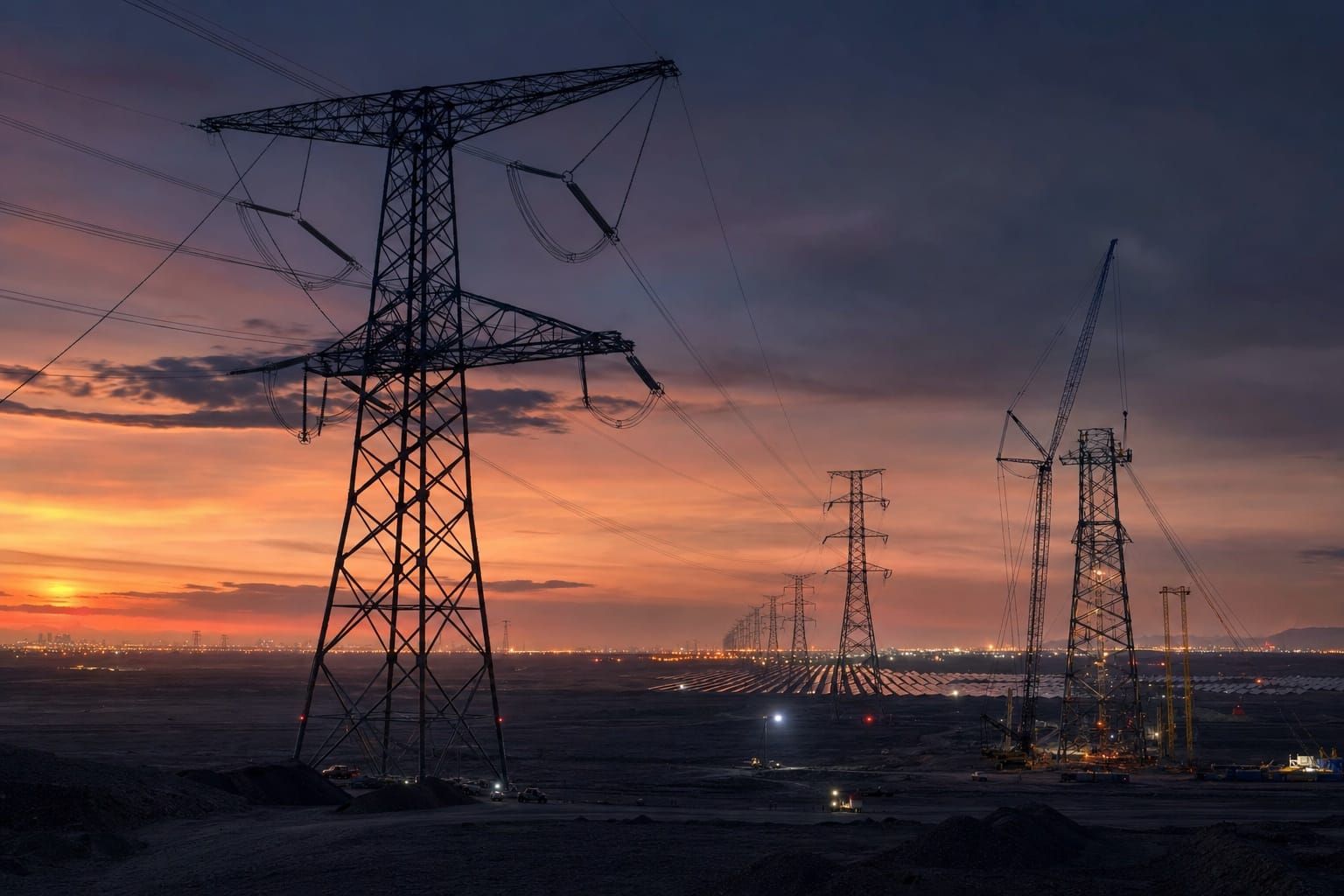
A solar farm can be built in about a year. The transmission line that connects it to the grid can take up to fifteen years to plan, permit, and build. That single mismatch — one sentence in UN Secretary-General António Guterres' speech in Antalya on Thursday — explains more about the next decade of energy markets than anything else said at COP31 this week.
On Wednesday, at the COP31 Leaders' Summit in Türkiye, a first group of countries endorsed the summit presidency's "35-by-35" pledge: raising electricity's share of final global energy use from roughly 23% today to 35% by 2035. It is the most concrete demand-side target a climate summit has produced in years — a commitment to run more of the world's cars, heat, buildings, and industry on electrons instead of molecules.
The next day, Guterres stood up at an event for the UN's new Global Grids Accelerator and quietly described why the pledge may collide with physics and paperwork. Some 3,000 gigawatts of advanced-stage renewable energy and battery projects are sitting in grid-connection queues around the world, he said — built or buildable generation that cannot deliver a single watt because the wires to carry it do not exist yet.
The world just promised to electrify. The waiting line for a power line is now the binding constraint on that promise.
The queue is the story
For most of the past decade, the energy transition debate was about generation: how fast solar and wind costs would fall, whether batteries would scale, whether clean power could compete without subsidies. That argument is largely over. By Guterres' count, two dollars now flow into clean energy for every dollar invested in fossil fuels. Renewables, as he put it, have gone "from alternative to unstoppable."
What has not kept pace is the infrastructure between the power plant and the plug. The International Energy Agency, in its Electricity 2026 outlook, describes grid investment lagging far behind generation investment, with rising congestion already forcing power systems to curtail — throw away — clean electricity they cannot move.
The scale of the required buildout is difficult to overstate. Guterres cited the need to build or upgrade more than 80 million kilometers of power lines by 2040 — enough cable, at the Earth's circumference of roughly 40,000 kilometers, to wrap the planet about two thousand times. Against that requirement, the current pace looks almost quaint: the world's leading utilities installed a record 21,000 kilometers of new grid in 2025, according to IRENA, with their collective transition investment topping $156 billion a year. A record year, and it covers a rounding error of the stated need.
That is why Guterres' headline ask in Antalya was not about panels or turbines. It was about money for wires: global grid investment, he said, must rise by around 50% by 2030, with multilateral banks providing the patient, low-cost capital that transmission projects need and private finance brought in early to shape bankable projects.
Briefings like this are free to read with a free AlphaBriefing membership. Join free →
Where the bottleneck bites hardest
The queue problem is global, but it is not evenly distributed.
In the rich world, the constraint is mostly procedural: interconnection backlogs, permitting timelines measured in decades, and supply chains for transformers and high-voltage cable that are sold out years ahead. The European Union's energy regulator ACER said last week that EU grid investment is expected to keep rising toward 2030 — while warning, according to Reuters, that delays and congestion could push costs higher. Building more slowly than demand grows is itself inflationary: somebody pays for congestion, and it is usually the ratepayer.
In the developing world, the constraint is capital. Guterres was blunt about the geography: the bottleneck is tightest in countries that are "rich in sun and wind but starved of investment." Six hundred million people in Africa still live without electricity. The Global Grids Accelerator — launched in September and formally showcased this week — is starting in Africa and Southeast Asia, backing the African Union's continental grid plan and the ASEAN Power Grid. Southeast Asia alone is set to account for nearly one fifth of global energy demand growth over the next decade, and currently imports 60% of its crude oil from the Middle East. For those governments, a regional grid is not climate policy; it is energy security policy that happens to decarbonize.
The market noticed before the diplomats did
Here is the part that should interest investors: the grid trade did not wait for COP31.
As of this week, GE Vernova — the turbines-and-grid spinoff that has become the purest large-cap way to own U.S. electrification — trades around $818, up roughly 47% over the past twelve months. Siemens Energy, one of the world's biggest suppliers of grid technology, is up about 31% over the same period at around €133. Prysmian, the Italian cable maker that sells the physical kilometers Guterres wants 80 million of, is up about 29% at around €109. Copper — the metal every one of those kilometers is made of — trades near $6.16 a pound on COMEX, up about 21% in a year.
The exception proves the rule: Hitachi, whose Hitachi Energy unit is one of the world's largest grid-equipment suppliers, is down about 7% over the past year in Tokyo — a reminder that conglomerate structure, currency, and valuation still matter even when the end market is booming. The picks-and-shovels trade is real, but it is not indiscriminate.
What the COP31 pledges change is not the direction of this trade but its political floor. A 35% electrification target, if even partially pursued, hardens demand for exactly the assets that are already scarce: HVDC converter stations, high-voltage transformers, subsea and underground cable, and the engineering firms that build them. Scarce assets with decade-long order books tend to have pricing power.
The honest caveats
Three things temper the enthusiasm, and a reader deserves all of them.
First, the pledge is voluntary and young. WRI, which tracks the process, described "a set of countries" endorsing 35-by-35 on day one while urging many more to join — diplomatic language for: the hard signatures are still being collected. No enforcement mechanism exists, and the gap between summit pledges and national grid plans is where climate commitments historically go to die.
Second, the money is not yet attached. The $1.3 trillion climate finance goal provides a headline number, but Guterres' 50%-by-2030 grid investment target is an exhortation, not a budget line. Transmission requires patient capital at low rates precisely at a moment when long-term rates in much of the world remain elevated.
Third, timelines do not compress on command. Even with reformed permitting, the 15-year transmission line does not become a 3-year project. The queue of 3,000 gigawatts will not clear this decade; the realistic question is whether it stops growing.
The bottom line: the energy transition's binding constraint has moved from generation to delivery, the world's governments just said so out loud, and the companies that resolve that constraint are among the few places in this market where demand visibility extends past 2030. The bottleneck is the business.
If this analysis was useful, this is what AlphaBriefing does every day — geopolitics and markets, connected to what it means for your money. A free membership gets you access to every free article on AlphaBriefing.com; paid members get the investment frameworks, scenario pricing, and catalyst calendars behind the paywall. Sign up free → — upgrade whenever it earns it.
Get this level of intelligence every day. Subscribe to AlphaBriefing — free, member, and paid tiers available.
Sources & Further Reading
- United Nations — Secretary-General's remarks to the COP31 Global Grids Accelerator high-level event (November 12, 2026)
- COP31 Presidency — 35-by-35 Global Electrification Pledge (full text)
- World Resources Institute — Countries Endorse 35x35 Electrification Pledge at COP31 (November 11, 2026)
- World Resources Institute — COP31 Leaders' Summit Spotlights Electrification and Transition Away from Fossil Fuels (November 12, 2026)
- IRENA — Utilities deliver record 21,000 km of new grid as transition investment tops USD 156 billion a year (November 10, 2026)
- IEA — Electricity 2026: Grids
- Reuters — EU grid investment to keep rising toward 2030, ACER says (November 6, 2026)
- UN News — At COP31, Guterres urges massive push on electricity grids (November 12, 2026)
Disclaimer
AlphaBriefing is an independent intelligence publication. The content in this article is produced for informational and educational purposes only. Nothing published by AlphaBriefing constitutes financial, investment, legal, tax, or regulatory advice, nor should it be construed as a solicitation or recommendation to buy, sell, or hold any security, asset, or financial instrument.
All views expressed are those of the author at the time of writing and are subject to change without notice. Markets are volatile and unpredictable; past performance is not indicative of future results. Any investment involves risk, including the possible loss of principal.
AlphaBriefing and its principals, employees, or contributors may hold positions in securities or assets mentioned in this article. This should be considered a potential conflict of interest. No material relationship with any company referenced exists unless explicitly disclosed. Readers should conduct their own due diligence and consult qualified financial, legal, and tax advisors before making any investment decisions.
Information in this article is drawn from public sources believed to be reliable at the time of publication. AlphaBriefing makes no warranty, express or implied, as to the accuracy, completeness, or timeliness of any information herein. AlphaBriefing accepts no liability for any loss or damage arising from reliance on this content.
© AlphaBriefing. All rights reserved. Unauthorised reproduction or distribution is prohibited.